Operations + systems for owner-led businesses

I help carry the work—and improve the way it gets done.

I’m Brian Boyd. I work with business owners on operational problems that need more than advice.

Bring me one stubborn task, a defined project, or an ongoing responsibility. I learn how the work actually happens, handle what we agree, and build practical improvements around the real work and its exceptions.

Start small · Keep going only where the work proves useful

Start with what keeps getting in the way.

The first job does not need to be large. It needs to be useful.

  1. 01A report nobody completely trusts.
  2. 02Information entered in three different places.
  3. 03Work that depends on one person’s memory.
  4. 04A recurring task that consumes more attention than it should.
  5. 05A system that technically works but does not fit the people using it.

If it matters and will not stay solved, put it on the table.

Three ways we can work together

A useful relationship can begin wherever the problem calls for it. You do not need to choose an arrangement before contacting me.

01

A defined project

Starts at $500

You have a specific problem or improvement in mind. We agree on the outcome, boundaries, price, and what “finished” means. It may be a small operational fix, a better process, a useful analysis, or a system built around a larger need.

02

A savings-share arrangement

Starts at $500

Some work has a clear baseline and a result that can be measured responsibly. When the fit is right, we can agree in advance on how verified savings will be calculated and share the value created. This is an option for suitable work—not a formula forced onto every problem.

03

Preferred way to workAn ongoing operations-and-systems partnership

Starts at $2,000

I take responsibility for agreed recurring work and learn the operation by doing it: the normal flow, the awkward exceptions, the missing information, and the decisions people make to keep things moving.

That matters because the written steps are rarely the whole job. On larger projects, a system can follow the specification and still miss what the business actually needs. Discovering the unmentioned exceptions afterward creates expensive rework.

In many cases, it is less expensive for me to help perform the work while I develop the solution. I encounter the exceptions firsthand and improve the system alongside the work it must support.

As the system becomes dependable, my hands-on time may decrease. My attention to the outcome does not. I remain independent while bringing an owner’s commitment to the work. This is the work I most enjoy.

Not every problem belongs with me.

Not every bottleneck, aggravating task, or business problem is suited to the way I work. Part of my responsibility is recognizing that early.

If I do not believe I am the right person for the job—or the likely benefit does not justify the time and cost—I will tell you.

A clear answer at the beginning is far less expensive than forcing the wrong engagement and discovering the mismatch later.

What happens after you reach out

  1. 01
    A free conversation. Phone or in person. You tell me what keeps getting in the way. If I am not the right fit, I will say so.
  2. 02
    I learn how the work really runs. For a small job, that may be one conversation. For larger work, a paid assessment maps where the time goes, and the document is yours to keep either way.
  3. 03
    A written proposal. It names the arrangement (a defined project, a savings share, or an ongoing partnership), the price, the scope, and what “finished” means. Nothing starts until you approve it.
  4. 04
    The work begins. I carry or build what we agreed, check it against the real operation, and stay long enough to see the effect.
One relationship · One evolving system

RFQ Hunter

An engagement with a small defense contractor exposed a larger operational challenge: important information was scattered across opportunity research, bidding, jobs, deliveries, inventory, invoicing, and payments.

Working inside that business led to RFQ Hunter.

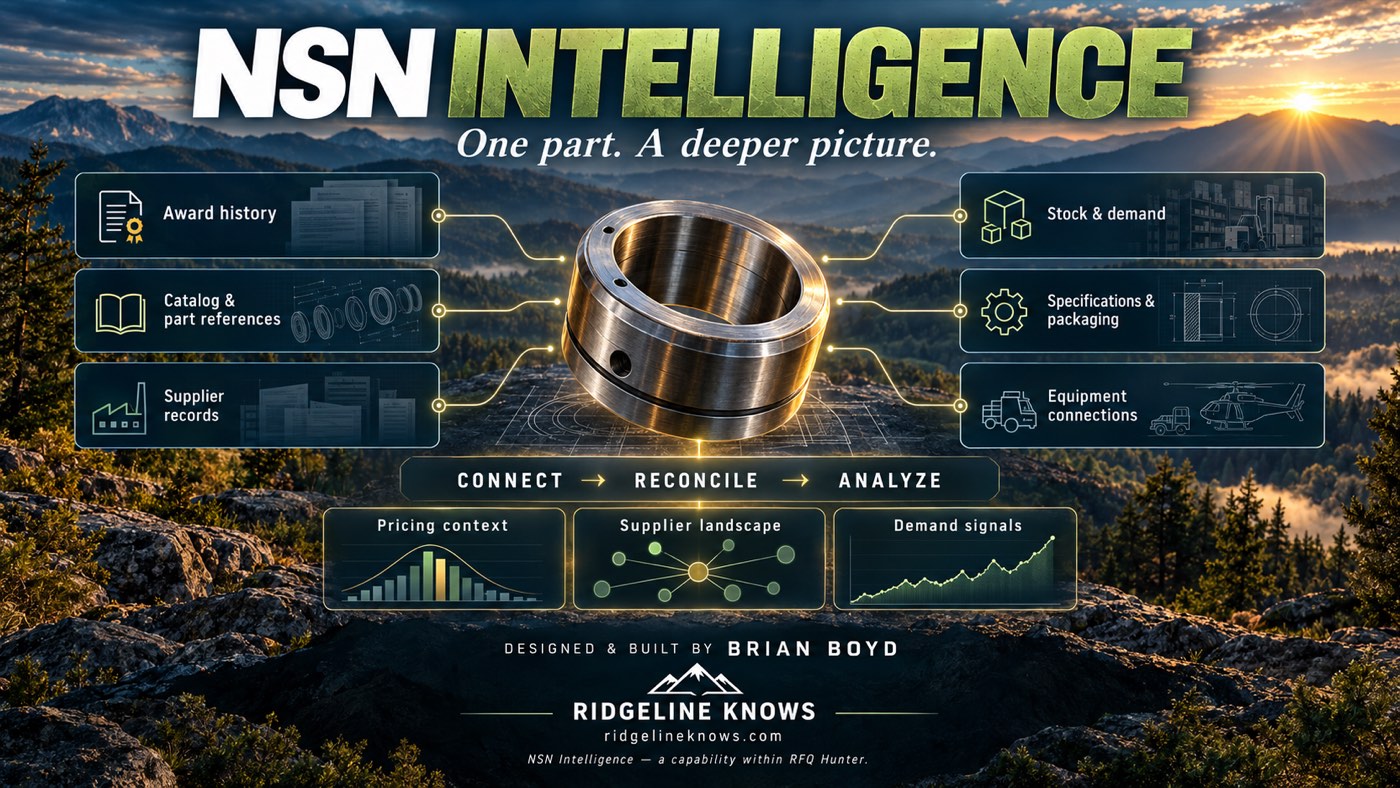
NSN Intelligence connects records about one industrial part into pricing context, supplier relationships, and demand signals.

Ridgeline Knows designed and built RFQ Hunter as a connected operating system for that work. The original client is now its sole tenant. I remain involved with the business, carrying agreed work and learning from the tasks and exceptions the system must support.

RFQ Hunter grew from this continuing client relationship, one operational problem at a time.

Why parts? Because that was the work I was already doing. A part is also a contained subject: everything in a full report on one part comes from 13 federal datasets. A service business would need connections to state, county, and city systems across the country. What carries over to your business is the method: learn how the work really runs, then build around it.

Portfolio piece · A capability within RFQ Hunter

One part. A deeper picture.

A single National Stock Number can connect to years of records spread across award history, catalog and part references, supplier records, stock and demand, specifications and packaging, and equipment connections.

NSN Intelligence brings those sources together inside RFQ Hunter. The value is not simply putting more data on a screen. It is understanding where the information came from, how the records relate, and what the apparent patterns do—and do not—mean.

Built today

NSN Intelligence exists as a capability within RFQ Hunter.

In practice

RFQ Hunter serves one private tenant. Individual workflow claims stay limited to confirmed use.

Portfolio piece

NSN Intelligence is here as an example of what I build. It is not a Ridgeline consulting service.

Try it

Search a real NSN for a free summary, or explore seven clearly fictional full reports. Full reports for real parts are available with report credits.

One part, all the way through

NSN Intelligence shows the depth available around one part. The broader operating story shows the other half of the work: how an opportunity can move through research, bidding, purchasing, delivery, inventory, invoicing, and payment.

Understand→Connect→Carry the work→Build→Stay to see the effect

Business knowledge first. Technology in service of it.

I use ChatGPT throughout Ridgeline Knows to investigate problems, organize knowledge, challenge assumptions, develop ideas, and help direct the work.

When the solution involves software, I also use Claude Code to build, test, and refine complex systems. Together, these tools expand what I can accomplish as an independent operator and builder.

The technology is not the offer.

My role is to understand the business, exercise judgment, direct the development, check the results, and remain accountable for whether the solution fits the real work.
Brian Boyd

Independent operator and builder.

I work best with owners who are willing to explain how the business really runs, let me participate in the work, and put useful improvements into practice.

You do not need a technology plan or a polished specification. You can begin with the task that keeps coming back, the information you cannot see clearly, or the process everyone has learned to work around.

11 — Start a conversation

What keeps getting in the way?

It may be a small job. It may be a recurring responsibility. It may eventually become a deeper operating partnership. We can start with a conversation and take on only what proves worthwhile.

By phone
Leave a message and I’ll return your call within a reasonable time — sometimes right away, sometimes a few hours, sometimes the next business day.
By email
Replies within two business days, usually the same business day.
Based in
Myrtle Beach, SC
Serving the Lowcountry to Myrtle Beach and beyond — and clients across the country.
At least a sentence or two (20 characters or more).