The capability exists.
It is present in the working system and supported by code and records.
RFQ Hunter began inside one small defense contractor—not as a software idea in search of a customer, but as a response to work that crossed research, jobs, inventory, outside partners, shipping, invoicing, and payment.
A written process can describe the normal route. It rarely captures every exception: a document with a newer layout, a number that means two different things, a payment filed under a related contract, or a handwritten line read differently on two passes.
Doing the work exposed those exceptions.
The exceptions changed the system.
The system made the next exception easier to see.
That loop—work, evidence, improvement, continued involvement—is the real RFQ Hunter story.
A small defense contractor asked me to find a better way to track inventory. They sent me the spreadsheet they were using, and I began developing a replacement.
But inventory was not an isolated list. To understand what each field meant and what the new process needed to support, I had to learn more about the business: the parts it supplied, how government contracts worked, where opportunities came from, and what happened after an award.
As I worked, I began using public records from DLA and other government sources to understand the parts more completely. A single National Stock Number could connect to years of awards, prices, suppliers, specifications, packaging requirements, government stock, published demand, and the equipment the part supported.
That created another opportunity. Instead of retyping years of handwritten history into a modern system, we could use official records to reconstruct much of it from the original government sources.
The government data did not eliminate the paper. It could tell us that a contract was awarded, something shipped, an invoice was submitted, or a payment was issued. It could not always tell us the company’s internal job number, what a handwritten code meant, why somebody handled an exception a certain way, or what happened between the official events. Scanned records and human review still complete the story.
For a time, I thought RFQ Hunter might become a software product used by many government contractors. I continued building it with separate workspaces for separate businesses.
Meanwhile, the original client kept bringing me other problems. Some were small. Some involved paper forms, spreadsheets, emails, government downloads, or information that existed in one part of the business but was needed somewhere else. I would often build the underlying capability into RFQ Hunter, then shape it around the client’s actual process.
Inventory became connected to jobs. Jobs led to outside processing and chain of custody. Shipping connected to invoicing. Government payment records connected back to the work that produced them. RFQ Hunter gradually became more than a tool for finding solicitations. It became an operating system for one business.
Much of the company’s working knowledge has traditionally lived in an experienced owner’s head, on paper, or inside spreadsheets. The owner still enjoys finding solicitations, preparing bids, and winning awards. Other recurring responsibilities are gradually being handed to another person as the owner steps back from more of the daily operation.
The small team also works from different locations. Paper records and operational details therefore arrive a little at a time rather than as one complete system that can simply be copied.
Putting the operation together is often more like assembling a puzzle than importing a clean dataset. It can be frustrating. It is also deeply rewarding when another piece finds its place and the wider picture becomes clearer.
Most consulting and development projects depend on a series of handoffs. The business explains its process to a consultant. The consultant turns what they were told into requirements. A developer builds what the requirements describe. Everyone can perform their part correctly and the finished system can still miss what the business actually needs.
What gets lost is rarely the normal path. It is the unusual invoice, the handwritten notation, the exception everyone handles from memory, or the spreadsheet that remains necessary because the main system never accounted for one awkward situation.
My preferred relationship reduces that distance. When I carry agreed recurring work while developing the system, I encounter those exceptions myself. I can see where the description and the operation separate, understand why the workaround exists, and improve the system around the real work rather than only the version captured in the requirements.
RFQ Hunter is still built as a multi-tenant platform, but today it serves one private tenant. I am completely comfortable with that.
I once imagined success as supporting hundreds or thousands of users on one product. Through this work, I learned that I prefer building alongside one business, understanding its exceptions, and staying involved long enough to see whether each improvement actually helps.
That relationship gives me more than customer feedback. It gives me direct experience with the operation the system is supposed to support. The system is not finished because the operation keeps revealing itself. That is not a failure of the model. It is the model.
The labels matter as much as the features.
It is present in the working system and supported by code and records.
Real tenant operations or review have exercised the capability.
It remains a direction that must earn its place through actual need.
A National Stock Number is a durable thread through federal supply data. RFQ Hunter uses that thread to bring separate records into one evidence trail.
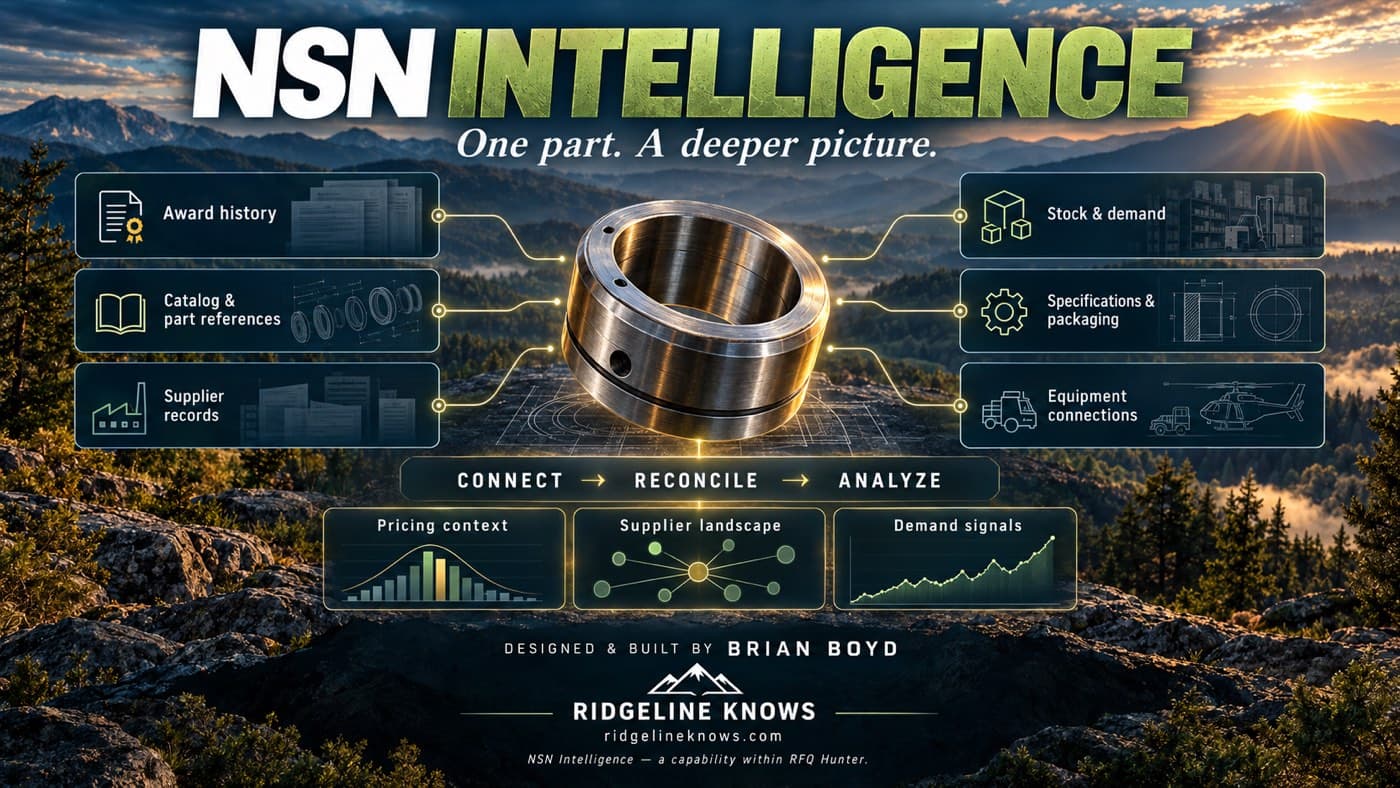
Awards, prices, competition, open solicitations, and published demand.
Names, specifications, acquisition codes, lead time, and supported equipment.
Approved sources, manufacturer references, packaging, stock, and reorder context.
Source limitations stay visible. A historical signal is never presented as a guarantee.
NSN Intelligence is a portfolio piece: an example of what I build, not a Ridgeline consulting service. Try it for a free summary, or explore seven fictional full reports. Full reports for real parts are available with report credits.
The larger value is the chain behind it: each step creates evidence the next step can use, while the places that still require a person remain visible.
RFQ Hunter brings in current DLA solicitations and ranks them against the tenant’s supplied parts, watched items, keywords, and federal supply classes. It helps narrow the field without pretending every opportunity deserves attention.
What a person still carries: The tenant’s established bidding method still happens outside this workflow. The capability exists; I do not present it as their normal practice.
NSN Intelligence connects award and price history, government stock and published demand, supplier and part references, specifications, packaging, acquisition details, lead times, and the equipment a part supports.
What a person still carries: The system shows the evidence and its limits. Historical price bands are context, not instructions, and published forecasts are labeled as the government’s figures.
The bid builder keeps the line items, pricing logic, packaging requirements, and supporting intelligence together. A submitted bid can move through won or lost without losing the record behind the decision.
What a person still carries: RFQ Hunter records the bid; it does not submit to the government portal. That final action and the outcome remain human decisions.
Most current jobs enter from the business’s existing paper process. Scanned job-order log sheets are read into a staging area, checked for arithmetic and possible duplicates, and reviewed before anything reaches the job book.
What a person still carries: The review is deliberate. A reader can be confidently wrong, so uncertain fields are highlighted without assuming that unflagged fields are perfect.
Job stages and inventory move together: beginning work commits stock, completion issues it, and cancellation releases it. Custody records show material handed to outside partners and what has returned.
What a person still carries: Some connections remain manual. A custody handoff can name a job without advancing it, because a person still needs to decide what the return means for the work.
Packing slips, vendor invoices, customer invoices, shipment records, and government submission notices sit in one operating workspace. Records can fill one another where the match is defensible and stop for review where it is not.
What a person still carries: Not every stage advances itself. Automation is used where incoming evidence is strong enough; a visible button or review queue remains where judgment matters.
Government payment records, bank deposits, receivables, and the job book are checked against one another. Disagreements become review work with the underlying evidence attached—not silent corrections.
What a person still carries: A flag means the records disagree. It does not claim which record is right. The system helps a person reach and preserve the answer.
RFQ Hunter demonstrates what can happen when I stay close enough to the work to see where the formal process stops matching reality.
Some improvements are software. Some are clearer review steps, better source records, or a decision not to automate something that still needs judgment. The point is not to remove people from the operation. It is to help them see and carry the operation more dependably.
I remain independent. I also remain involved long enough to see what the system changes—and what it still misses.
It may be a small job. It may be a recurring responsibility. It may eventually become a deeper operating partnership. We can start with a conversation and take on only what proves worthwhile.